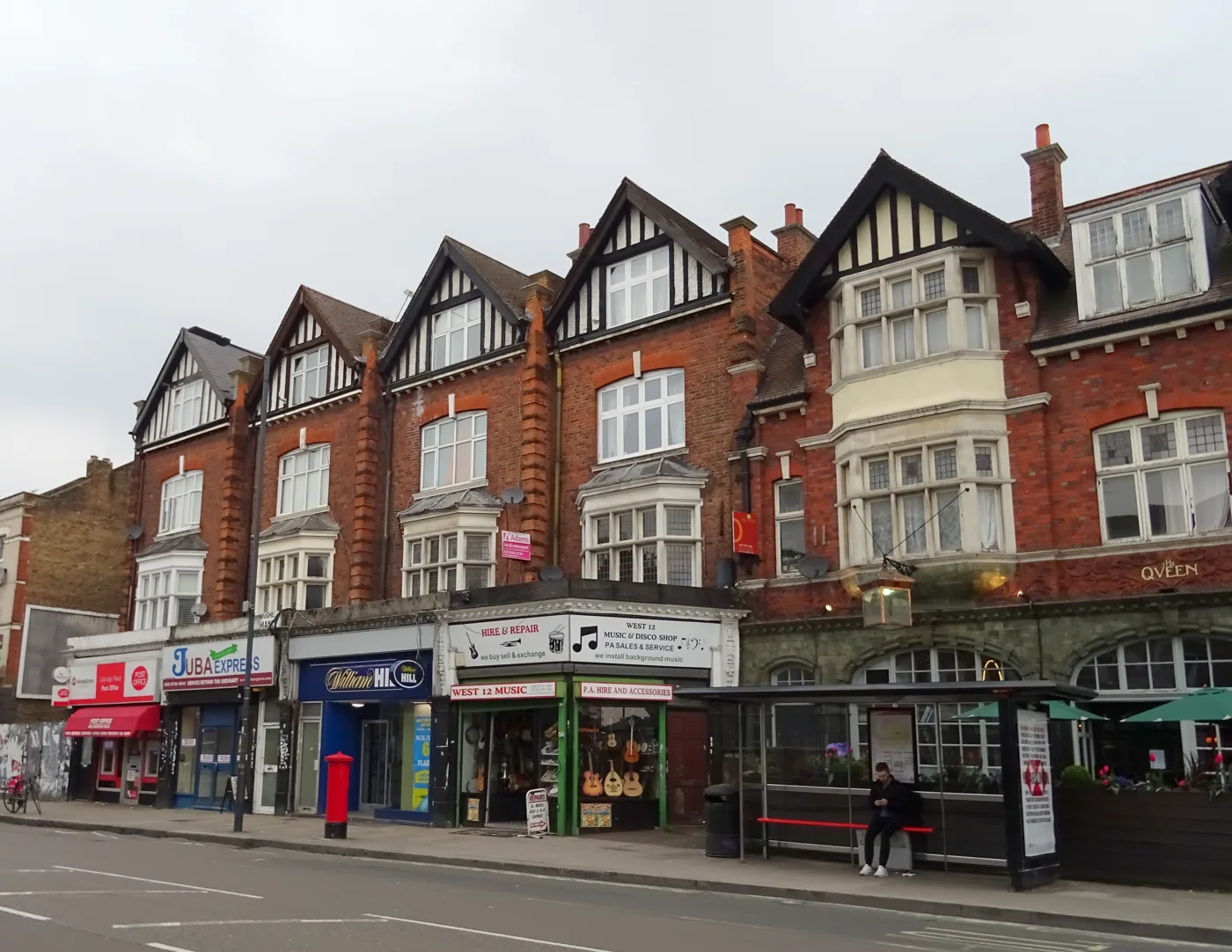

Shops on Uxbridge Road must clear their A-boards off the pavement from October or face £100 fines. The council counted up to 950 unlicensed boards borough-wide, and has issued just one licence.
Advertising boards will be banned from the pavement along Uxbridge Road from October, and shopkeepers who leave one out will be fined £100. The ban runs for 12 months as a trial. Hammersmith and Fulham Council will then decide whether to extend it across the whole borough.
Councillor Nicole Trehy, the Cabinet Member for Climate Emergency and Travel, took the decision on 28 August. It is a key decision and the call-in deadline is 3 September, so it can still be challenged by councillors as this is published.
Uxbridge Road runs through Shepherd’s Bush and Askew, roughly two miles north of Fulham. The trial covers the stretch from the junction with Ariel Way, by Westfield, west to the boundary with Ealing. It also takes in the side roads off Uxbridge Road, up to the point where premises fronting the main road end.
The council has issued one A-board licence in the whole borough
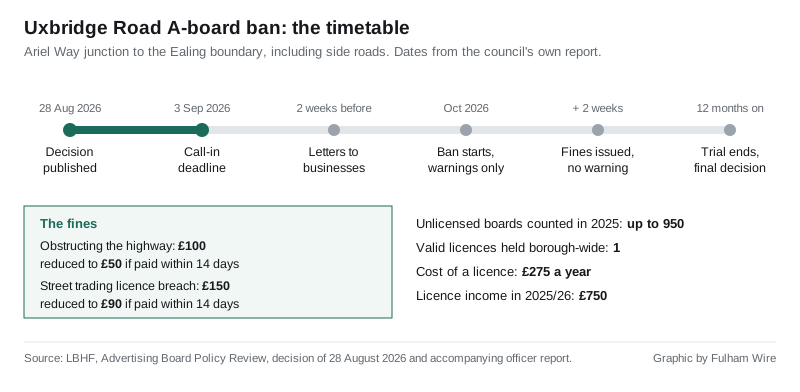
The officer report is blunt about the gap between the rules and the street. Three figures carry it:
- A 2025 survey found up to 950 unlicensed A-boards across the borough.
- The council holds one valid A-board licence, and that business is not on Uxbridge Road.
- A licence costs £275 a year. In 2025/26 the finance system recorded income from just three of them, £750 in total.
Placing a board on the highway without the council’s permission is not a technicality. The report cites section 148 of the Highways Act 1980, which makes it a criminal offence to deposit something on the highway that interrupts a highway user. Only the council, as highway authority, can give lawful authority for it.
Officers say the current approach has not worked. Businesses are asked to move boards, they do, and the boards come back. The report puts it plainly: “Without a realistic prospect of a fine or other formal consequence, there is little incentive for sustained compliance.”
What happens, and when
The report sets out the timetable for the trial:
- Officers write to affected Uxbridge Road businesses two weeks before the ban starts, explaining the date and the consequences.
- Businesses are asked to remove boards voluntarily before enforcement begins.
- For the first two weeks of the trial, the Law Enforcement Service issues warnings only.
- After that, a Fixed Penalty Notice is issued without further warning.
Two different fines apply, depending on which power is used:
| Offence | Fine | Discount |
|---|---|---|
| Obstructing the highway, s.148(1) Highways Act 1980 | £100 within 28 days | £50 if paid within 14 days |
| Breach of a street trading licence, s.34(1) London Local Authorities Act 1990 | £150 | £90 if paid within 14 days |
Failing to pay a fixed penalty can lead to prosecution.
Why Uxbridge Road, and who asked for it
The road has drawn repeated complaints from residents. The report records boards placed in the middle of the footway, near crossings, beside bus stops and next to tactile paving. Some businesses have more than one board, and as many as four. Some leave boards out when the shop is shut. Some boards do not advertise the business they stand outside.
The sharpest objection comes from disabled residents. Blind and partially sighted people often navigate by the building line, and a board pushes them off it into the middle of the pavement. The council’s Disabled Residents Team met officers and asked for:
- one board per 50 metres at most, if any are allowed
- a review of the designs permitted
- boards kept away from shop entrances
- help for businesses to advertise in ways that do not clutter the street
- planning conditions on new shops that rule out A-boards from the start
One member of the team said they would support a complete ban if it were possible.
The council also surveyed businesses on Uxbridge Road, and the response was thin. Only five replied, which the report itself says makes broader conclusions hard to draw. Of those five, three had put a board outside their premises and none held a valid highway licence. Three thought the council should ban boards from the highway. Four thought boards should be allowed only on private forecourts. All five said keeping pavements clear and accessible was important or very important.
Most inner London boroughs already say no
Officers benchmarked other authorities. The split is roughly even in number, but the weight sits with prohibition:
- Do not license A-boards on the highway: Westminster, Kensington and Chelsea, Camden, City of London, Transport for London, Hackney, Lambeth, Brent.
- Do license or permit them: Islington, Southwark, Ealing, Tower Hamlets, Hounslow, Richmond.
Westminster classes them as illegal advertisements and operates zero tolerance. Camden directs businesses to use their own forecourts instead. Hammersmith and Fulham’s current position sits with the second group.
Forecourts are a different matter
A board standing wholly on a private forecourt does not need a highway licence. It falls under the Town and Country Planning (Control of Advertisements) (England) Regulations 2007, which give deemed consent for advertisements relating to the business, up to 4.6 square metres in total and 1.55 square metres for any single sign.
That is a real loophole and the report accepts it. Deemed consent allows more than one board on a forecourt. Removing that right needs evidence, a chance for businesses to self-regulate, and eventually a direction from the Secretary of State. Officers describe the process as “very time consuming”.
There is one catch for shops with a street trading licence covering their forecourt. Where that applies, only one board is allowed, it must be a traditional A-frame, and it must not exceed 1,000mm high or 600mm wide. Swing signs, wheeled signs, rotating signs, menu stands and banners are all out.
The trial also reaches further than the kerb line in one respect. Where the statutory street trading provisions apply, it covers land within seven metres of a road or footway that falls within the definition of a “street” under Part III of the London Local Authorities Act 1990.
The borough-wide decision comes later
Alongside the trial, the council will run a six-week consultation across the whole borough on two options. Option 1 keeps the licensing scheme and enforces it harder. Option 2 bans A-boards from the public highway everywhere and withdraws the current policy.
The consultation will also ask whether any exceptions should apply, how forecourts should be treated, and how long businesses should get to adjust. The trial will be monitored for changes in clutter, accessibility, complaint levels, enforcement effort and whether boards simply move to neighbouring streets. Both results go into the final report.
What it means for you
If you run a shop on Uxbridge Road. Expect a letter about two weeks before October. Take the board off the pavement before the ban starts, and check whether the ground you use is actually yours. Forecourts that the public has walked across freely for years can count as highway. If you have a street trading licence covering a forecourt, one A-frame board is the limit, and it must come in when trading stops.
If you run a shop anywhere else in the borough. Nothing changes yet, but a licence costs £275 a year and the council is asking whether to stop issuing them at all. The consultation is where to say so.
If you walk, wheel or push a buggy along the road. The pavement should start clearing in October. The council wants to hear whether it actually does, and it has said it will go back to Uxbridge Road businesses and disabled residents’ representatives after the ban starts.
If you want to object to the decision itself. The call-in window closes on 3 September. After that the trial proceeds.
Fixed penalties are not convictions, and anyone issued one can put their case rather than pay. For other council rules that catch households and businesses in the borough, see our guides to parking in Fulham and Fulham planning applications.
Sources: London Borough of Hammersmith and Fulham, Advertising Board Policy Review decision, 28 August 2026, and the accompanying officer report.
Have your say